Spice Lab
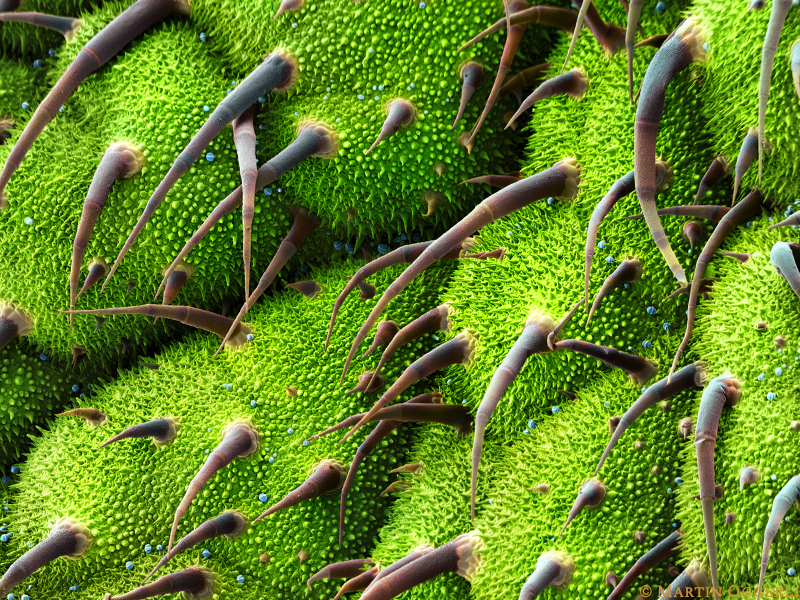
Lemon balm leaf (Melissa officinalis)Hand-colored Scanning Electron Micrograph (SEM) of the Lemon balm (Melissa officinalis) leaf surface by Martin Oeggerli.
Lemon balm is a perennial herb from the mint family, native to south-central Europe. Leaves, which have a mild lemon aroma, are used to make tea and medicine since 16th century. They have a mild lemon scent similar to mint, and are used for digestive problems, including: upset stomach, bloating, intestinal gas (flatulence), vomiting, and colic. Additional Lemonbalm can be used to treat: pain (menstrual cramps, headache, toothache), for mental disorders (Alzheimer's disease, attention deficit-hyperactivity disorder, hysteria and melancholia), and to treat autoimmune disease involving the thyroid (Graves' disease), swollen airways, rapid heartbeat due to nervousness, high blood pressure, sores, tumors, and insect bites.
Furthermore, Lemon balm leaf contains: eugenol, tannins, and terpenes, (+)-citronellal, 1-octen-3-ol, 10-α-cadinol, 3-octanol, 3-octanone, α-cubebene, α-humulene, β-bourbonene, caffeic acid, caryophyllene, caryophyllene oxide, catechin, chlorogenic acid, cis-3-hexenol, cis-ocimene, citral A, citral B, copaene, δ-cadinene, eugenyl acetate, γ-cadinene, geranial, geraniol, geranyl acetate, germacrene D, isogeranial, linalool, luteolin-7-glucoside, methylheptenone, neral, nerol, octyl benzoate, oleanolic acid, pomolic acid ((1R)-hydroxyursolic acid), protocatechuic acid, rhamnazin, rosmarinic acid, stachyose, succinic acid, thymol, trans-ocimene and ursolic acid.
Rosmarinic acid appears to be the most important active component, but the interaction with all other chemicals remains poorly understood.
Lemon balm is a perennial herb from the mint family, native to south-central Europe. Leaves, which have a mild lemon aroma, are used to make tea and medicine since 16th century. They have a mild lemon scent similar to mint, and are used for digestive problems, including: upset stomach, bloating, intestinal gas (flatulence), vomiting, and colic. Additional Lemonbalm can be used to treat: pain (menstrual cramps, headache, toothache), for mental disorders (Alzheimer's disease, attention deficit-hyperactivity disorder, hysteria and melancholia), and to treat autoimmune disease involving the thyroid (Graves' disease), swollen airways, rapid heartbeat due to nervousness, high blood pressure, sores, tumors, and insect bites.
Furthermore, Lemon balm leaf contains: eugenol, tannins, and terpenes, (+)-citronellal, 1-octen-3-ol, 10-α-cadinol, 3-octanol, 3-octanone, α-cubebene, α-humulene, β-bourbonene, caffeic acid, caryophyllene, caryophyllene oxide, catechin, chlorogenic acid, cis-3-hexenol, cis-ocimene, citral A, citral B, copaene, δ-cadinene, eugenyl acetate, γ-cadinene, geranial, geraniol, geranyl acetate, germacrene D, isogeranial, linalool, luteolin-7-glucoside, methylheptenone, neral, nerol, octyl benzoate, oleanolic acid, pomolic acid ((1R)-hydroxyursolic acid), protocatechuic acid, rhamnazin, rosmarinic acid, stachyose, succinic acid, thymol, trans-ocimene and ursolic acid.
Rosmarinic acid appears to be the most important active component, but the interaction with all other chemicals remains poorly understood.